
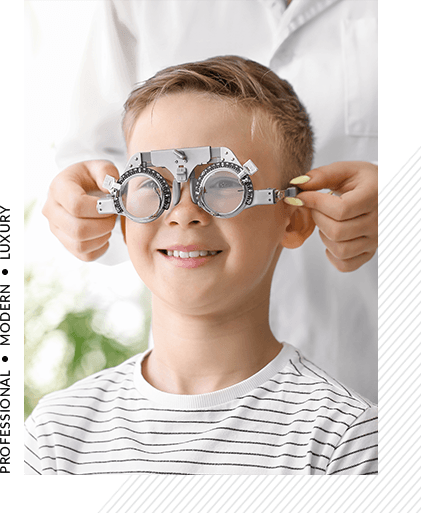
Myopia in Children: Why Prescriptions Keep Changing
If your child was recently diagnosed with myopia — or nearsightedness — you’re not alone. Myopia is one of the most common vision conditions in children today, and if you’ve noticed their glasses prescription getting stronger every year, there’s a good reason for that. The good news? Understanding why it happens can help you take steps to slow it down.
So, What Exactly Is Myopia?
Myopia happens when the eye grows slightly too long, causing light to focus in front of the retina rather than directly on it. The result: distant objects look blurry, but close-up things are clear. In children, the eyes are still growing — which is exactly why prescriptions tend to shift, sometimes year after year.
This isn’t just a glasses inconvenience. Higher levels of myopia are associated with a greater risk of serious eye conditions later in life, including retinal detachment, glaucoma, and macular degeneration. That’s why catching it early and managing it proactively really matters.
Why Is Myopia So Common Right Now?
Myopia rates have been climbing steadily over the past few decades, and researchers point to a combination of genetic and environmental factors.
Genetics play a role. If one parent is myopic, a child’s risk roughly doubles. If both parents are myopic, that risk increases even further. But genetics alone don’t explain the dramatic rise we’re seeing — lifestyle and environment are major contributors too.
Age of onset matters. Children who develop myopia early (before age 10) tend to experience faster progression. The younger the onset, generally the higher the final prescription will be.
The Environmental Factors Parents Should Know About
Here’s where things get really interesting — and empowering. Research consistently shows that certain everyday habits and environments can significantly influence how quickly myopia develops and progresses.
Too much near work. Extended time spent reading, doing homework, or staring at screens puts sustained focusing demand on young eyes. When the eyes spend long periods focused up close, it may signal the eye to keep growing — worsening myopia over time.
Not enough time outdoors. This one surprises a lot of parents: outdoor time is one of the most well-supported protective factors against myopia. Studies suggest that children who spend at least 90 minutes to 2 hours outside each day have a significantly lower risk of developing myopia. Natural light and the ability to focus at varying distances both appear to play a role.
Too much screen time. Tablets, phones, and computers aren’t inherently evil, but the combination of prolonged near focus and reduced outdoor time creates a perfect storm for myopia progression.
What You Can Do to Help
The great news is that small, consistent changes to your child’s daily routine can make a real difference. Here are some practical steps to consider:
Encourage outdoor play every day. Aim for at least 1.5–2 hours outside in natural light. It doesn’t have to be structured sports — a walk, time at the park, or playing in the backyard all count.
Follow the 20-20-20 rule. For every 20 minutes of near work or screen time, encourage your child to look at something 20 feet away for 20 seconds. It gives the eyes a much-needed break.
Create healthy reading habits. Reading material should be held at a comfortable arm’s length — not right up to the face. Good lighting helps too.
Limit recreational screen time. This is easier said than done, we know! But setting daily limits on non-essential screen use can help reduce the total near-focus burden on growing eyes.
Keep up with annual eye exams. Myopia can progress quickly in children, especially between the ages of 6 and 16. Regular check-ups allow your optometrist to track changes, update prescriptions as needed, and discuss whether myopia management options — such as specialized contact lenses, atropine drops, or orthokeratology — might be right for your child.
The Bottom Line
A changing prescription isn’t something to panic about, but it is something to take seriously. Myopia is manageable, especially when it’s caught early and supported by healthy daily habits. The combination of outdoor time, mindful screen use, and consistent eye care can go a long way in protecting your child’s vision for the long haul.
Think your child might be due for an eye exam — or have questions about myopia management? The team at ERC Optometry is here to help. Book an appointment with us today and let’s take a closer look at your child’s vision together.
Quick Links To Our Service Pages
EYE DISEASE DIAGNOSIS & MANAGEMENT
LASER EYE SURGERY CO-MANAGEMENT
ERC Optometry is a boutique optometry clinic located in Brooklin, Ontario, proudly serving patients throughout Durham Region including Whitby, Oshawa, Ajax, Pickering, Port Perry, Uxbridge, and surrounding communities. We offer comprehensive eye exams, dry eye disease management and treatment, specialty contact lenses, myopia management, ocular disease management, and a curated boutique optical.