
Myopia Management Explained: Glasses, Contacts, Ortho-K & Atropine
Managing your child’s nearsightedness is no longer just about getting a stronger pair of glasses every year. Today, myopia management is a proactive clinical approach designed to slow down the physical elongation of the eye, protecting your child’s long-term vision health.
At ERC Optometry, we use the latest evidence-based treatments to help children in the Durham Region maintain clearer vision and healthier eyes for life.
Why Simple Glasses Aren’t Enough
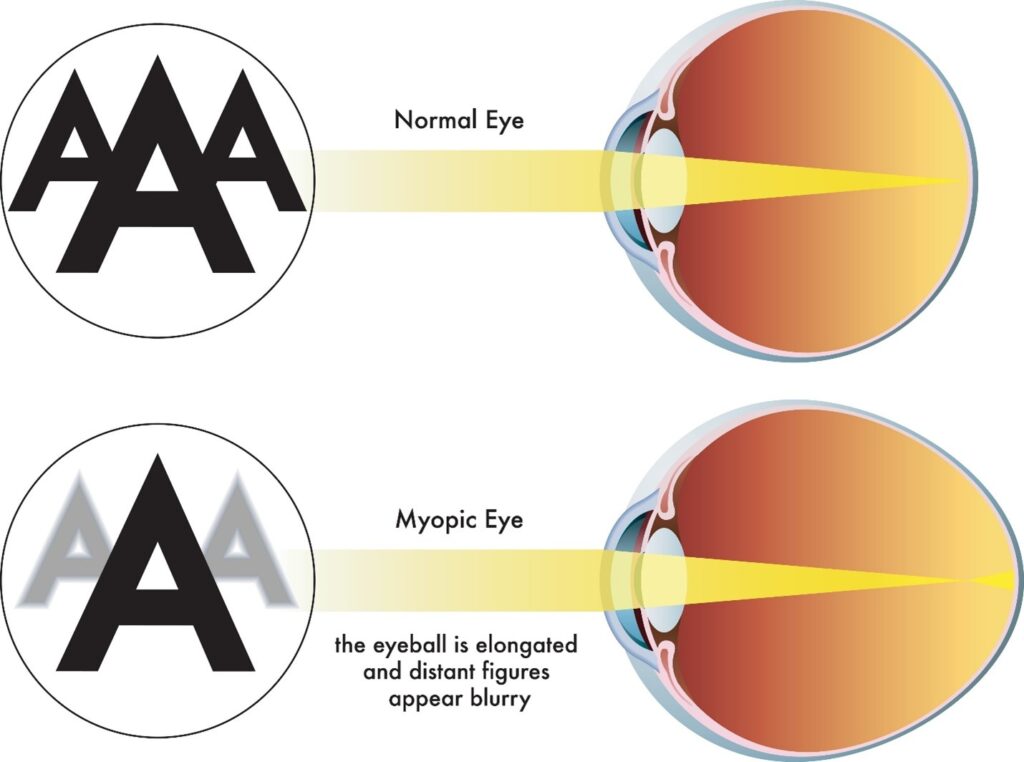
Standard “single-vision” glasses only correct the blur; they do nothing to stop the underlying cause of myopia—the eye growing too long. As the eye stretches, the risk for serious conditions later in life increases significantly:
| Condition | Risk with High Myopia vs. Normal Vision |
| Retinal Detachment | Up to 21x higher risk |
| Macular Degeneration | Up to 40x higher risk |
| Glaucoma | Up to 3x higher risk |
| Cataracts | Up to 5x higher risk (earlier onset) |
The Big Four: Modern Myopia Treatments
- Specialized Myopia Glasses (e.g., Stellest or MiYOSMART)
Unlike regular lenses, these use “D.I.M.S.” or “H.A.L.T.” technology. They provide clear vision in the center while creating a specific type of peripheral blur (defocus) that signals the eye to stop growing.
- Best for: Children as young as 6 who aren’t ready for contacts.
- Effectiveness: Shown to slow progression by up to 60–70%.
- Orthokeratology (Ortho-K)
Often called “braces for your eyes,” Ortho-K involves wearing custom, gas-permeable lenses only while sleeping. They gently reshape the cornea overnight.
- The Perk: When your child wakes up, they remove the lenses and can see clearly all day without glasses or contacts.
- Best for: Active kids, swimmers, and athletes.
- Effectiveness: Reduces axial elongation by up to 63%
- Soft Contacts (e.g., MiSight®)
These are daily disposable lenses worn during the day. They use a “dual-focus” design that corrects the child’s vision while simultaneously treating the myopia.
- The Perk: No cleaning or storage is required—just a fresh pair every morning.
- Effectiveness: Proven to slow myopia progression by an average of 59%.
- Low-Dose Atropine Eye Drops
This is a pharmacological approach. A medicated drop (usually 0.01% to 0.05% concentration) is placed in the eyes at bedtime.
- How it works: It influences biochemical signals in the retina to slow axial elongation.
- Best for: Very young children or as a “booster” alongside glasses or Ortho-K for children with rapid progression.
- Effectiveness: Reduces progression by approximately 30-60%
The “Double-Action” Advantage: Combining Treatments for Better Results
Sometimes, one layer of protection isn’t enough to keep a child’s vision stable. For kids whose eyes are changing quickly, we often recommend a “double-action” approach. This involves using a primary treatment during the day or night and adding a nightly “booster” drop.
New clinical research from 2025 and 2026 shows that this combination acts like a powerful insurance policy for your child’s eyes. This works whether we are combining specialized myopia-control glasses (like D.I.M.S. or H.A.L.T.) or Ortho-K overnight lenses with low-dose atropine drops. While the lenses (specialized glasses and contacts) provide the physical signal to the eye to stay the correct shape, the drops work behind the scenes to chemically slow down the stretching process. The results are impressive: children using both treatments together are over three times more likely to achieve zero eye growth over an entire year compared to those using only one method. At ERC Optometry, we use these combined therapies to give “fast-progressing” eyes the best possible chance at staying healthy and stable for the long run.
Lifestyle Habits: The “Outdoor Rule”
No matter which treatment you choose, lifestyle plays a massive role. Research consistently shows that spending at least 90–120 minutes outdoors daily significantly delays the onset and slows the progression of myopia. Sunlight triggers dopamine release in the retina, which helps regulate eye growth.
The 20-20-20 Rule for Digital Work:
To reduce “near-work” strain, encourage your child to:
- Every 20 minutes,
- Look 20 feet away,
- For 20 seconds.
Is Your Child a Candidate?
The “window of opportunity” for myopia management is typically between the ages of 6 and 14, as this is when the eye grows most rapidly. Early intervention is the key to preventing “High Myopia.” If your child is outside this “window of opportunity” they may still be eligible for treatment.
Ready to protect your child’s vision?
Book a Myopia Management Consultation at ERC Optometry today. We’ll perform a thorough assessment, including axial length measurements, to determine the best customized plan for your family.
Quick Links To Our Service Pages
EYE DISEASE DIAGNOSIS & MANAGEMENT
LASER EYE SURGERY CO-MANAGEMENT
ERC Optometry is a boutique optometry clinic located in Brooklin, Ontario, proudly serving patients throughout Durham Region including Whitby, Oshawa, Ajax, Pickering, Port Perry, Uxbridge, and surrounding communities. We offer comprehensive eye exams, dry eye disease management and treatment, specialty contact lenses, myopia management, ocular disease management, and a curated boutique optical.